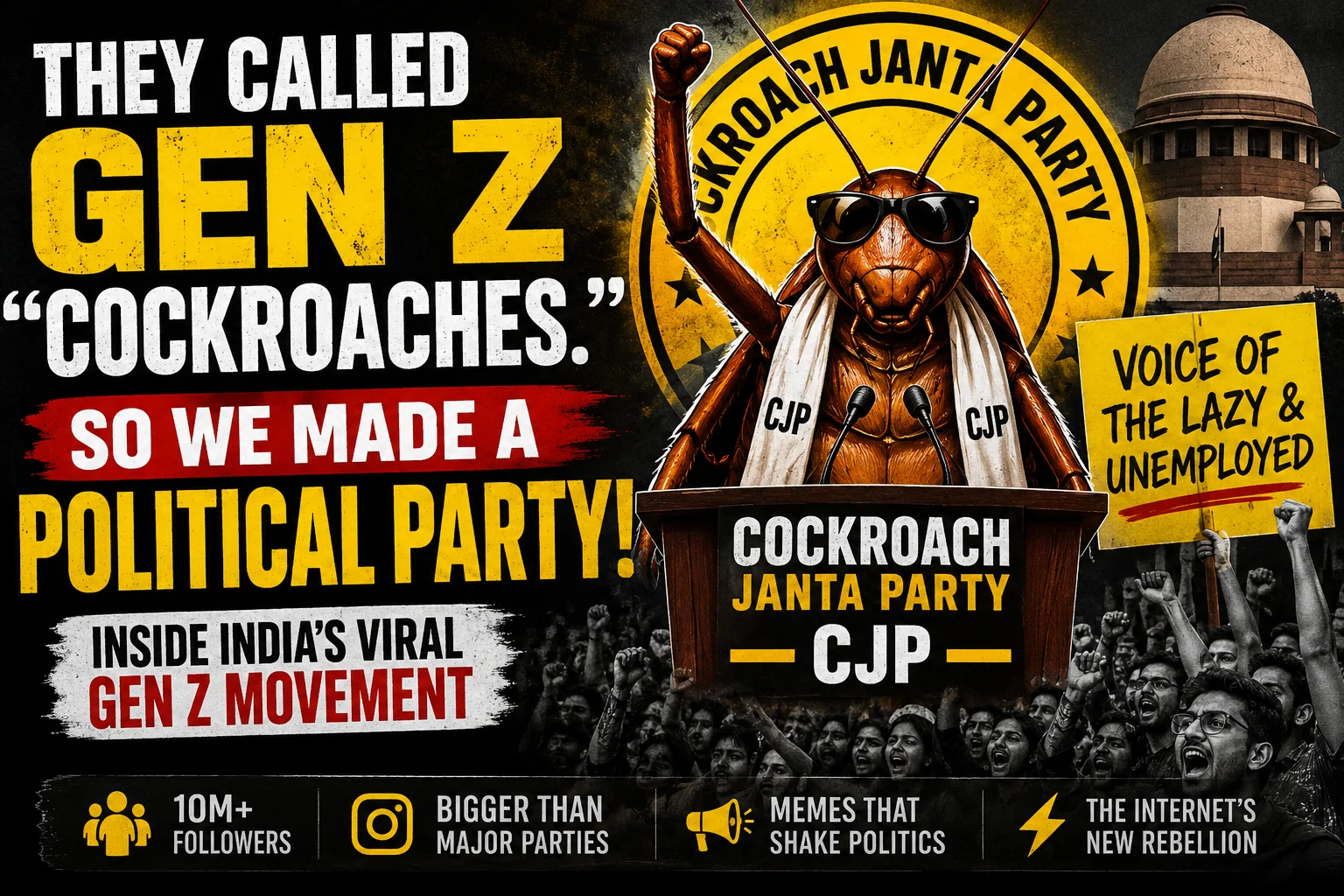
How the Cockroach Janta Party Became India’s Most Viral Political Movement Overnight
India’s internet has officially entered its meme-politics era.
What started as outrage over controversial “cockroach” remarks has now exploded into one of the country’s biggest viral youth movements: the Cockroach Janta Party (CJP).
In just a few days, the satirical political movement reportedly crossed millions of followers online, triggered national debate, attracted celebrity attention, and sparked comparisons to Gen Z protest waves seen across South Asia.
And unlike traditional political campaigns filled with speeches and manifestos, this one runs almost entirely on memes, sarcasm, Instagram reels, and internet culture.
What Is the Cockroach Janta Party?
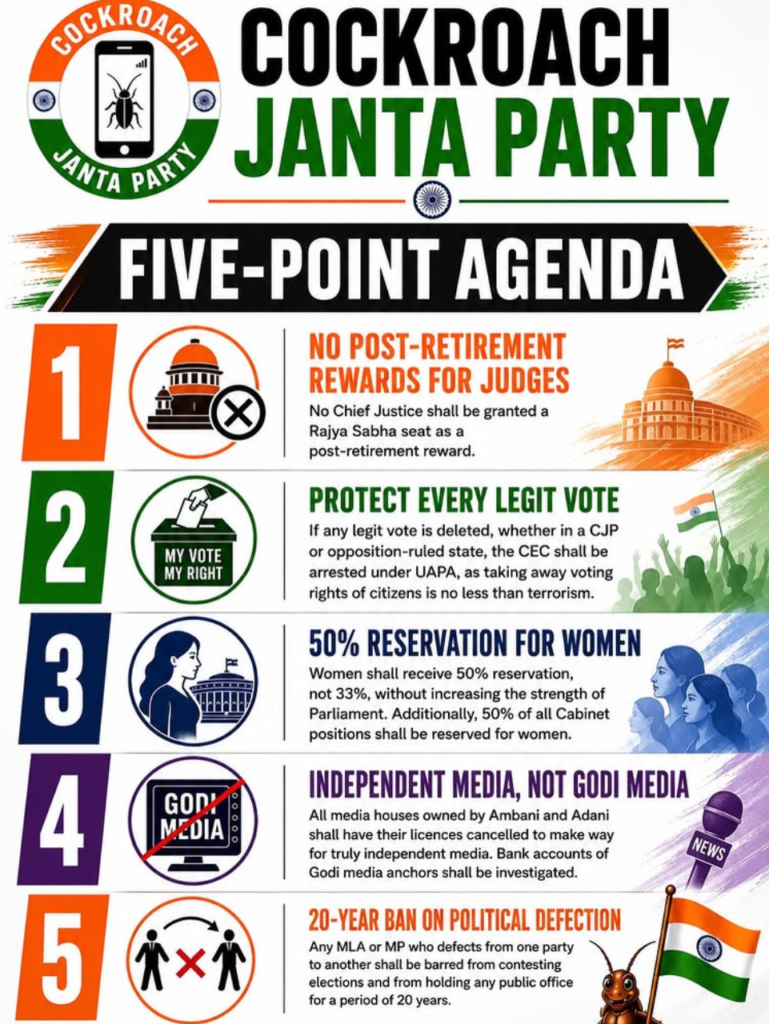
The Cockroach Janta Party (CJP) is a viral satirical political movement founded by Abhijeet Dipke, a political communication strategist and former volunteer associated with the Aam Aadmi Party.
The movement reportedly emerged after controversial remarks involving the word “cockroach” during a court-related discussion went viral online. While the original comments became heavily debated and interpreted differently across social media, Gen Z users quickly transformed the insult into a symbol of rebellion and identity.
Instead of getting offended, the internet did what the internet does best:
It made memes.
Then it made a movement.
From Meme to Movement

Within days, the Cockroach Janta Party became one of the fastest-growing political satire pages in India.
Reports claim the movement crossed more than 10 million followers on Instagram, even surpassing some mainstream political parties online.
The account brands itself as:
“The voice of the lazy and unemployed.”
That line alone perfectly captured the frustration of a generation dealing with:
- Unemployment
- Exam paper leaks
- Political fatigue
- Rising internet cynicism
- Meme-driven activism
And Gen Z immediately connected with it.
Why Gen Z Is Obsessed With It
The success of Cockroach Janta Party isn’t really about cockroaches.
It’s about recognition.
For years, young Indians have complained about being ignored, mocked, or reduced to stereotypes online. CJP flipped that narrative by weaponizing humor.
The movement mixes:
- Political satire
- Absurdist memes
- Anti-establishment commentary
- Instagram-native storytelling
- Internet irony
And somehow, it works.
According to interviews given by founder Abhijeet Dipke, the movement began impulsively after a single viral social media post asking:
“What if all the cockroaches came together?”
That one sentence became the foundation of an internet rebellion.
The Internet’s New Political Language
Traditional political campaigns rely on rallies.
Cockroach Janta Party relies on:
- Meme templates
- Viral captions
- Reels
- Comment wars
- Online symbolism
Its rise also shows how political communication is changing in India.
For Gen Z, Instagram is now more influential than television debates.
A viral meme can outperform a political speech.
And a parody account can generate more engagement than national parties.
That’s exactly why CJP exploded.
Celebrities and Politicians Are Already Joining the Wave
The movement has already attracted attention from celebrities, comedians, journalists, and opposition figures online.
Reports mention support or engagement from personalities including:
That celebrity amplification pushed the movement even further into mainstream conversation.
But There’s Also Controversy
As expected, the movement has also triggered backlash.
Questions are now being asked online:
- Is this real activism or just satire?
- Is it secretly political?
- Can meme movements influence real elections?
- Could this evolve into an actual youth party?
The controversy intensified further after reports emerged that the party’s X account had been withheld in India.
That only added more fuel to the movement’s viral momentum.
Because on the internet, nothing spreads faster than censorship claims.
Why This Movement Matters
Even if Cockroach Janta Party disappears tomorrow, it has already exposed something important:
India’s youth are no longer engaging with politics the old way.
They don’t want:
- boring speeches
- scripted debates
- television shouting matches
They want:
- authenticity
- humor
- relatability
- digital-first communication
CJP understood internet culture better than most political strategists.
That’s why it spread so quickly.
The Bigger Question
The real question isn’t whether Cockroach Janta Party becomes a real political party.
The real question is:
What happens when millions of frustrated young people discover they can organize themselves through memes?
Because that’s what makes this story different.
This wasn’t built by TV networks.
It wasn’t built by billionaires.
It was built by reposts, reels, screenshots, and internet rage.
And that may be the biggest political shift India has seen in years.
Final Thoughts
The Cockroach Janta Party may have started as satire.
But the emotions behind it are very real.
Underneath the memes and jokes is a generation that feels unheard, underrepresented, and exhausted by traditional politics.
And for now, they’ve chosen a cockroach as their mascot.
Not because it’s glamorous.
But because it survives everything.